
How to Avoid LED Shadowing in SEG Lightboxes
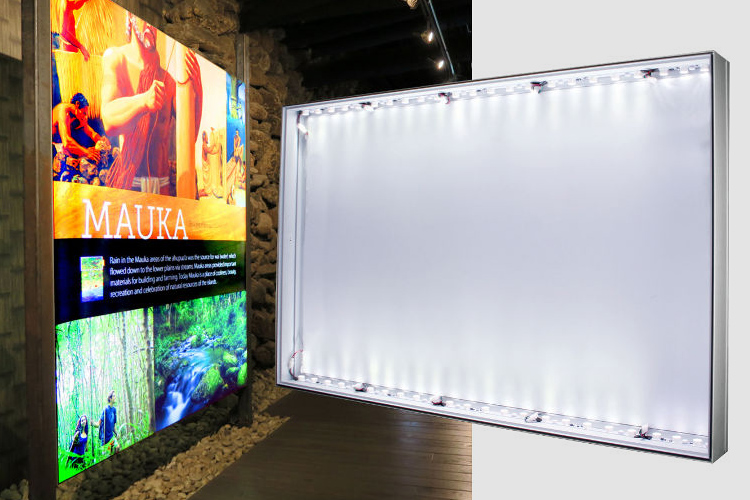
LED shadowing is one of the most common issues in SEG lightbox graphics.
It shows up as hotspots, visible LED strip patterns, or uneven brightness across the image. While it often gets blamed on fabric, shadowing is almost always a system issue involving lighting, frame depth, diffusion, and fabric working together.
Here is what actually matters.
1. Use the Right Backlit Fabric
Not all fabrics are suitable for lightboxes.
For SEG applications, use a knitted polyester backlit fabric designed for LED diffusion. Knit construction scatters light more evenly than woven fabric and reduces the chance of visible grid patterns or hotspots.
Fabric alone cannot fix poor lighting, but the wrong fabric will always make shadowing worse.
2. Match Fabric Opacity to Frame Depth
Fabric opacity must align with how far the LEDs sit behind the graphic.
Shallow frames require higher-opacity fabrics to help mask LED points. Deeper frames allow more flexibility. If fabric is too sheer, hotspots appear. If it is too dense, brightness drops and uneven illumination becomes more noticeable.
Always test the fabric with the actual frame depth and lighting system being used.
3. LED Spacing and Layout Matter More Than Brightness
Shadowing is rarely solved by increasing LED brightness. In many cases, higher output makes hotspots more obvious.
Even illumination comes from:
-
Consistent LED spacing
-
Adequate distance from the fabric
-
Balanced power across the entire frame
LEDs placed too close to the fabric or spaced unevenly will show through regardless of fabric choice.
In many lightbox applications, LEDs installed on two opposing sides of the frame produce more balanced illumination than lighting all four sides. When LEDs are placed on every side, cross-lighting can concentrate brightness in the corners, creating uneven illumination that is difficult to correct with fabric alone.
4. Use White Blockout Fabric to Control Light
White blockout fabric prevents light from escaping through the back of the frame and reflects it forward through the graphic. This improves brightness, reduces hotspots and shadowing, and helps maintain color contrast.
If the extrusion is black or a dark color, the interior walls and any internal support bars positioned in front of the blockout fabric should be finished in white to maximize light dispersion.
In lightbox systems designed with multiple blockout positions, placing the blockout farther from the face graphic can help improve light uniformity.
5. Tension and Printing Affect Light Uniformity
Uneven tension can exaggerate lighting issues. Overstretched fabric becomes thinner and more transparent, allowing LED points to show through.
Make sure:
-
Silicone is sewn consistently
-
The correct silicone size is used for the frame
-
Fabric is evenly tensioned on all sides
Ink density also matters. Heavy ink coverage or very dark colors can block light unevenly. Use backlit-specific color profiles and avoid over-inking.
6. Test Before Final Install
Always test the assembled lightbox with the graphic installed. Look for hotspots, dark zones, or color shifts before shipping or installing. Catching issues early prevents reprints and field failures.
Get Your Lightboxes Right the First Time
Avoiding LED shadowing in SEG lightboxes is about balance. Proper backlit fabric, correct frame depth, consistent LED spacing, adequate diffusion, and even tension all work together.
When the system is designed correctly, the result is smooth, even illumination that meets retail and brand expectations.
If you need SEG frames designed to work with professional backlit fabrics, Direct LED Frames has systems in stock and ready to ship.